Transit of Mercury, November 8, 2006
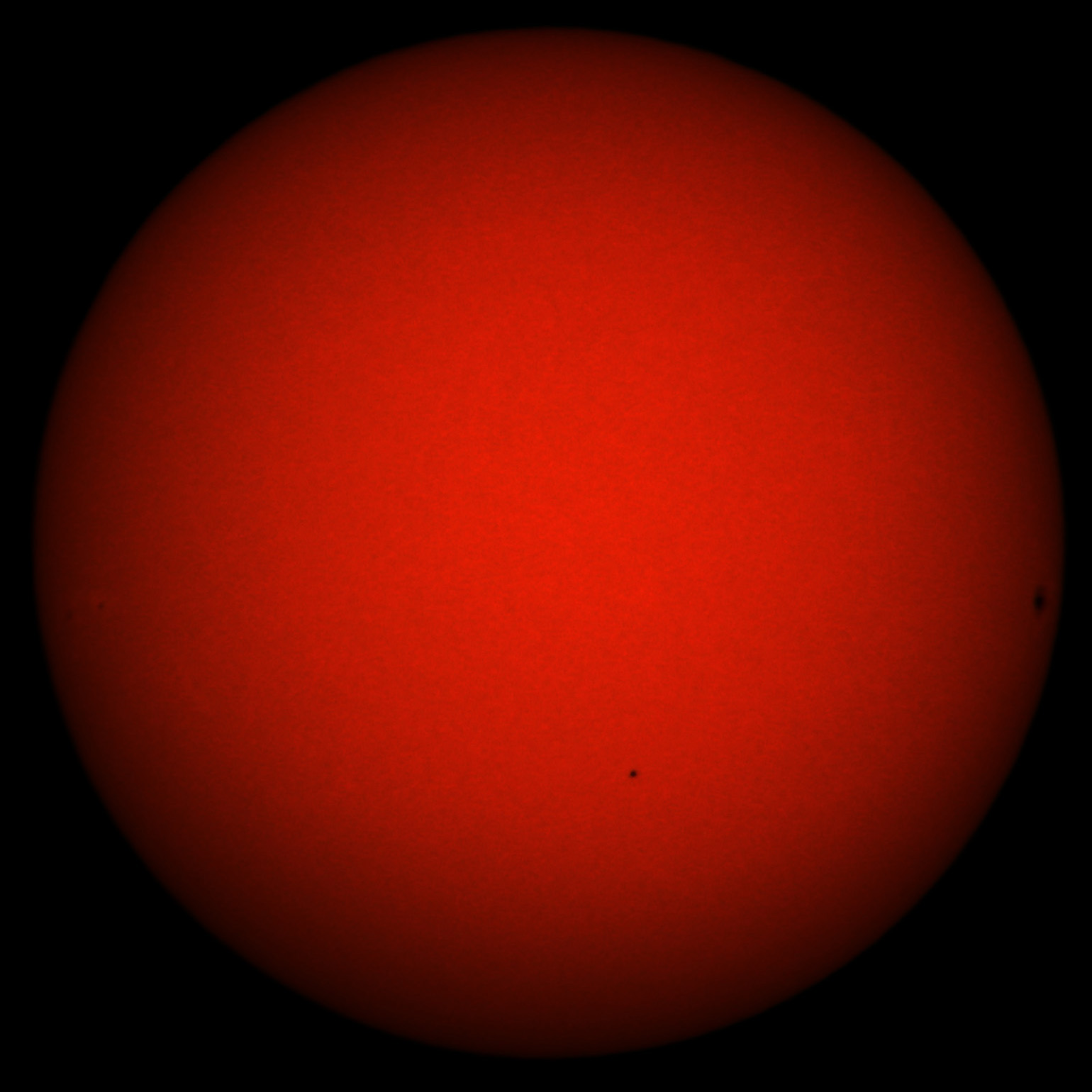
Fragment of a high-resolution image taken through ETX70 with solar filter and Canon G3. Click on image to see full image. It was obtained by stacking of two images taken less than a minute apart at approximately 14.01 PST and processed in Photoshop.
Luckily I got two good images only less than a minute apart. I stacked them for the image above. This stacking partially answers my concern about details visible on Sun photographed with G3: some of the "details" are indeed matrix noise but some of them are actually surface features that probably are well visible only with H-alpha filter. I want to look deeper into this issue later.
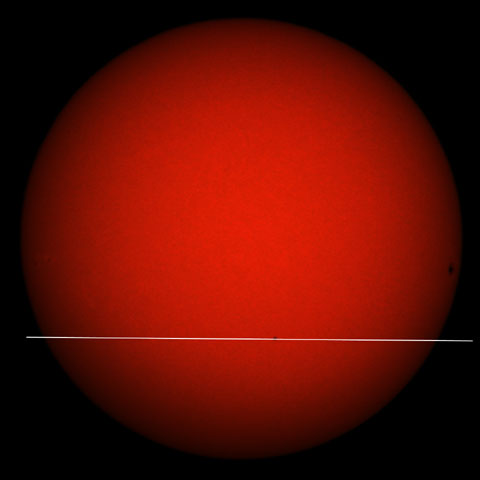
An approximate path of Mercury across Sun disk.
The line fit manually in Photoshop by two images taken about 15 min
apart.
I want to do a better fit using all of the images I took. The plan is to
register them to each other and then the fit line using all available
positions.
NASA: Transit of Mercury: image

NASA: Transit of Mercury
Where it was visible (the entire event was visible from San Francisco, but buildings were obscuring it on early and late hours)
Time laps movies of the transit Ca-K version is especially spectacular since it also clearly shows Sun rotation.