back to logs

back to the main page


The Whirlpool Galaxy M51, with SAC8 and ETX 70
Yosemite West, July 2004

On the long weekend of July 4, 2004, we went to Yosemite for three days. I took Meade ETX70 and SAC8 with me and spent three nights trying to take a picture of M51.

Yosemite supposed to be virtually free of light pollution. However Moon was very bright and the sky was lit quite a bit. First two nights I spent just trying to locate the object: I scanned the area where M51 should be and didn't find anything. And it was the only reasonably bright deep sky object that supposedly was visible from the balcony of the vacation house we rented. Although I practiced taking picture of random areas in the sky it was rather depressing to go to Yosemite and didn't take advantage of that.

On the third night, even though I didn't see M51 through the eyepiece, I decided to take some "blind" pictures. I aligned telescope with Alcor which is not so far from where M51 should be. Then I used Goto feature of ETX70 to point at Whirlpool Galaxy. After staring at rather starless area where Goto pointed the scope I thought that I see a vey faint fuzzy spot. It was a little bit more conspicious with averted vision.

Switching the eyepiece with SAC8 and bringing such faint object into focus would be practically impossible without having flip mirror built into ETX70. I used the camera port to attach diagonal with CCD camera and used the other port for the eyepiece. While pointing the scope at Alcor I focused the camera and the eyepiece simultaniously, then pointed at the galaxy again. After playing with exposure time I stopped at 20 sec and captures few dozens of frames. Yet only few of them were free of obvious tracking problems.
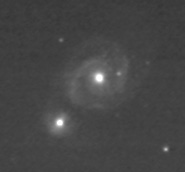
A stack of three 20 sec exposures minus dark frame. I subtracted dark frame in Fits (an application that comes with SAC8) and stacked in RegiStax. No flat field was applied.
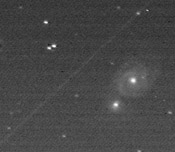
In two hours, while taking pictures of the galaxy, I saw several satellites crossing field of view. As it turned out later I even captured two. A meteor zoomed by across the view once. As Moon was rising the images of the galaxy were more and more washed out with a brighter background. At the end of the session I was not able to see it any more even with averted vision.
A trail left on the image by a satellite. Single frame (minus dark) tweaked and filtered down in Photoshop.
Three nights at Yosemite was definitely not enough. The conditions there could be nearly ideal. The air was very still. The forest was giving virtually no IR radiation and no heat waves that are plentiful in my urban neighbourhood. I wish I were there when Moon was in a more favorable phase.

Links to M51:
Messier 51 at seds.org, Hubble view of M51, More NASA on M51, Some more of M51


After playing for awhile with RadioShack power supply that I bough solely for SAC8 I swtiched to power supply from a retired computer. In normal operation it provides 12V for periferals. Shorting two pins on the main power cable makes it work without the rest of the computer. Strangely the voltage in the stripped configuration was slightly lower (about 10.2V) but the imager worked with it much better than with 13.8V from RadioShack power source. The computer power supply apparently has an advantage of a better stability and apparently is powerful enough for the camera. After I switched to the new power source all crashes, funky USB behavior and most of the annoying noise on the images disappeared.

Another note is that I will look into obtaining some sort of filter wheel before attempting RGB imaging of deep sky objects. It would be very unproductive to spend time on achieving parfocal configuration every time I change or add a filter.


back to logs

back to the main page