Observing Saturn
and Moon on February 28, 2004,
or Konus Maksutov Cassegrain 150 First Light
The two first targets I was after were Saturn and Moon. The seeing was pretty bad. The air was humid with both high and low clouds. Since I was in rush to see at least something, I skipped polar alignment. So I had to chase my targets by turning scope manually. A good focus was nearly impossible to reach because of the quite turbulent atmosphere. The tripod (an upgraded version of EQ5) was a bit shaky. Every time I was touching focus knob it would take several seconds before I could see a stable image. Meanwhile the target would travel away and I had to turn the scope again, with more shaking. Nevertheless in about one hour session I managed to glimpse some views of Moon and Saturn.
Because of the focus problems when looking at Saturn I had hard time to resolve Cassini division. The disk itself showed no colors. Capturing Saturn on camera prooved to be even trickier. On top of the old camera focus problem I had a bunch of other issues.
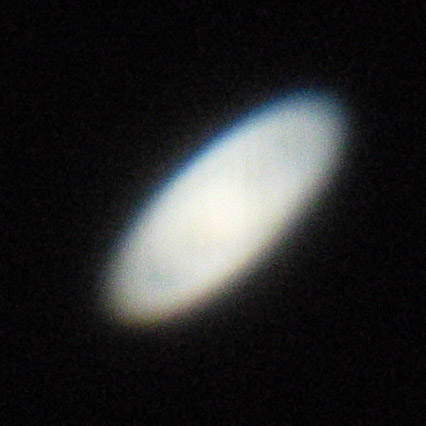
Click on the thumbnail for the full resolution image.
Apparently the entire optical pass (the scope with the eyepiece and the camera) shows quite a bit of chromatic aberration. It was not that apparent during visual observaton.
In mid-Februrary I also got step rings for my Sony TRV25 camcorder. Like with the camera I attached it to MaxView eyepiece. When trying the camcorder with the new scope I found that shooting on video is much more forgiving for bad tracking (read - no tracking :-) and turbulence. Saturn was already covered by clouds so I turned the scope to Moon. Below are test shots of Alpine Valley and Straight Wall.
Click on the image to the left to play the flick..
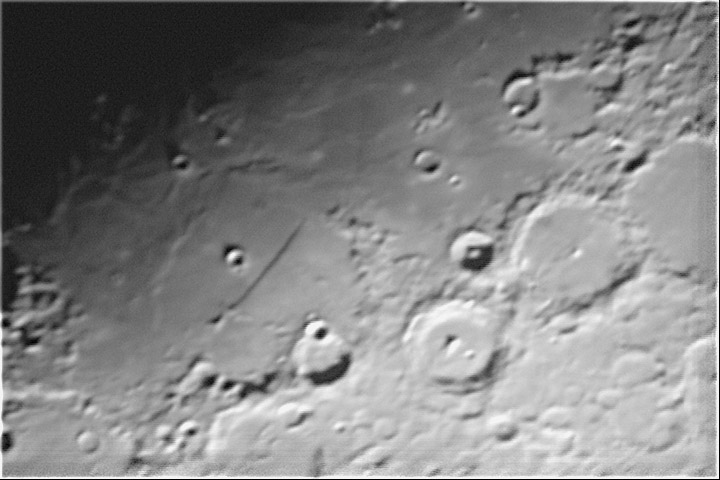
Click on the thumbnail for the full resolution image.
Overall my first impression of Konus 150 is rather positive. The weather was not quite good for testing of the scope optical quality, so I’d wait with a more detailed evaluation. Because of rush I didn’t do proper alignment and tracking so the tripod will wait for more conclusive tests too.