Konus MotorMax 150
There are some good reviews of this particular piece of equipment published already. The best one that I found (much later after purchasing the scope) is on CloudyNights.com [1]. My notes here can be considered as a personal commentary/addition to that excellent review.

General view of Konus MotorMax 150
Actually, I appreciated this only later when I unpacked much more expensive Meade LX90GPS where a number of bolts and washers were on the loose inside the box and I nearly discarded them.
Optics appear
to be of good quality, but the actual star tests are yet to be
preformed. So far I can tell that it produces nice textbook Airy disks
for stars images. Out-of-focus images look symmetrical as they supposed
to look on well collimated optical tube assembly (OTA).
Tripod is quite sturdy and adequate for the OTA. Any vibrations
disappear within couple of seconds.
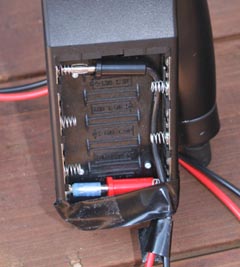
"Hacking" the wires to connect DC to the controller
Polar scope is a great addition but it is not illuminated. It makes it much harder to use.
Balancing OTA is quite tricky: even after 2 years in the field the gears are rather stiff.
German Equatorial Mount (GEM) is very nice to have but the quality of the gears and motors is, well, exactly what you would expect for this price: between ok and mediocre. They have noticeable lag. When turning motors "on", it is necessary to tighten fixation rings. Tightening them sets the scope off its orientation. Finding the target, then tightening rings can be quite frustrating at times.
Exposure time for astrophotography is limited by the drive errors to max about 30 sec. While the scope can keep targets longer in the view, the precision is not suitable for long exposures. Absence of computer control and periodic error correction (PEC) is a very limiting factor. (That's what makes the scope more affordable on the up side...)
Focuser produces quite noticeable shift.
Yet the planetary and lunar images obtained with this scope are quite spectacular. Saturn rings are well resolved and Cassini division is clearly visible on a night of good seeing. Jupiter atmosphere reveals some details as well. On Mars I also could see some large surface details in summer of 2005, the seeing was not perfect though.
Portability is one of the major advantages of this scope - one person can easily move it out for an observation session.
Few things I want to do in the future to make this review more complete:
- perform actual star testing following [3],
- measure drives characteristics,
- measure focuser shift.